

Signing up for online music classes for the first time comes with a fair amount of uncertainty. Will it actually work over a screen? Can a teacher really catch technique mistakes through a webcam? Most of that hesitation clears up within the first lesson itself, but it helps to know what's coming before you log in for the first time.
Why Online Music Classes Have Become a Reliable Way to Learn
A few years ago, learning an instrument almost always meant sitting in a physical classroom. That's changed. Online music learning has grown into a legitimate, structured path, not just a backup option for people who can't make it to a school in person.
Online music classes from Chennai instructors remove that barrier entirely, letting students learn from home without sacrificing the structure a good music school actually offers.
What You Need Before Your First Online Music Class
Getting set up properly beforehand makes the first class go a lot smoother. You don't need expensive equipment, just the basics done right.
A stable internet connection matters more than people expect. Lag during a music lesson isn't just annoying, it actually disrupts timing and rhythm feedback, which are core parts of learning an instrument. A laptop or tablet with a decent camera works better than a phone, mainly because a bigger screen makes it easier to see hand positioning or finger placement clearly.
If you're learning piano or keyboard, having the instrument set up in the same room as your device, rather than in a different corner of the house, saves a lot of back-and-forth during the actual lesson. For guitar or violin students, make sure there's enough space to hold the instrument comfortably while still staying visible on camera.
What to Expect in Your First Online Music Lesson
The first lesson usually isn't about diving straight into technique. Most instructors spend the initial session getting a sense of where a student's starting from, even complete beginners have different comfort levels with rhythm, listening, or prior musical exposure.
Expect a short conversation about goals. Why are you learning this instrument? Is it for personal enjoyment, a certification path like ABRSM or Trinity, or something else entirely? This shapes how the rest of the course gets structured.
After that, most first lessons cover basic posture, how to hold the instrument correctly, and a simple introduction to the very first exercise or note. It's rarely overwhelming. Good instructors keep the first session light, focused more on comfort and confidence than technical mastery.
How Teachers Correct Technique in Online Music Lessons
This one comes up more than anything else when people are deciding on online music lessons. Can a teacher actually spot and fix mistakes through a screen the same way they would sitting right next to you?
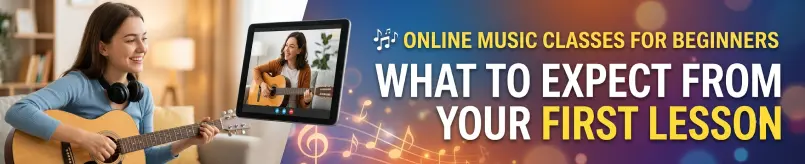
Mostly, yes, though the approach looks a bit different. A lot of instructors ask students to angle the camera specifically toward their hands or posture, instead of just capturing whatever the general room view happens to show. Some also play alongside the student in real time on a split screen, so any gap in technique shows up right away.
Recorded practice has turned into a pretty common tool as well. A student records a practice session between classes, the instructor reviews it before the next one, and catches things that might've slipped past in a single live lesson.
How Fast Can You Expect to Progress with Online Music Lessons?
Progress online tends to follow roughly the same timeline as in-person lessons, as long as practice stays consistent and the setup's stable. What actually changes isn't the skill-building itself, it's the discipline needed to stay on track without a physical classroom nudging that routine along.
Students who take online lessons just as seriously as they would an in-person class, showing up on time, practicing in between, staying focused during the session, tend to progress just as well as anyone learning in a room with a teacher.
Common Challenges Beginners Face in Online Music Classes
Technical glitches happen now and then, a connection drops, there's a bit of audio delay, or the camera angle needs fixing mid-lesson. None of that means online learning doesn't work. It's just part of getting used to the format, and most students barely notice these hiccups after the first few sessions.
Staying motivated without classmates in the room can feel different at first too. Students who used to get energy off a group class in person sometimes need a little time adjusting to something more one-on-one. That usually sorts itself out once regular performances or online recitals become part of the routine.
What to Look for in a Good Online Music School
Not every online music program is built the same way. A few things separate a genuinely structured program from a loosely organized one.
Look for instructors who actually specialize in teaching online, not just musicians who moved their in-person lessons to a video call without adjusting their teaching approach. The best online music lessons account for the format specifically, using camera angles, recorded feedback, and digital practice tools designed for remote learning.
Certification pathways matter here too. A program that actually prepares students for ABRSM or Trinity College London exams, even online, shows a level of structure that casual, loosely run lessons usually don't have.
Quick Tips to Get the Most Out of Your Online Music Lessons
- Stick to a consistent practice schedule, ideally around the same time each day, so it becomes routine
- Keep your instrument and device in the same spot to cut down on setup time before each lesson
- Record yourself practicing between sessions and actually watch it back honestly before the next class
- Just ask your instructor if the camera needs repositioning for better technique visibility, don't guess
- Stay as present during video lessons as you would in a physical classroom, and cut the distractions
Start Your Online Music Learning Journey Today
Learning an instrument online isn't really a compromise anymore. It's just a different format, and it works well as long as the structure and teaching behind it are solid. What actually matters is consistent practice, a proper setup, and instructors who understand how to teach through a screen, not ones who just moved an in-person lesson onto a video call without changing anything.
Tune In School of Music offers online music classes from India to students across the US, UK, Canada, and beyond, teaching piano, keyboard, guitar, violin, drums, and music theory, alongside in-person lessons out of their Avadi, Chennai location. Their certified faculty prepares students for ABRSM and Trinity College London certifications, whether that's happening in a Chennai classroom or from a living room in New York, London, or Toronto. For anyone in the US, UK, or Canada wanting to learn music online without losing the structure and personal attention a real music school offers, these online music classes from India usually end up making the biggest difference in how far a student actually gets.